
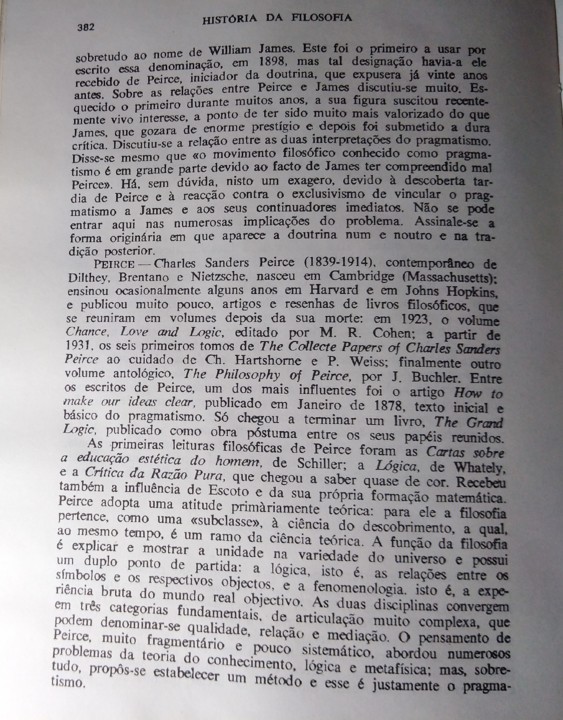
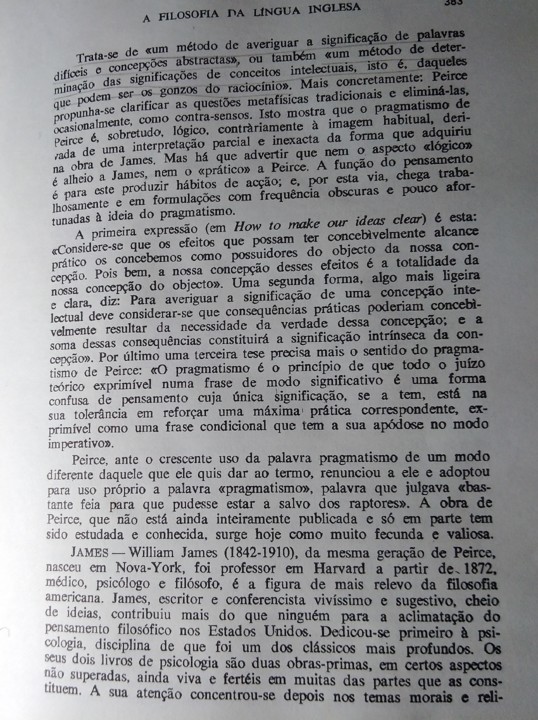
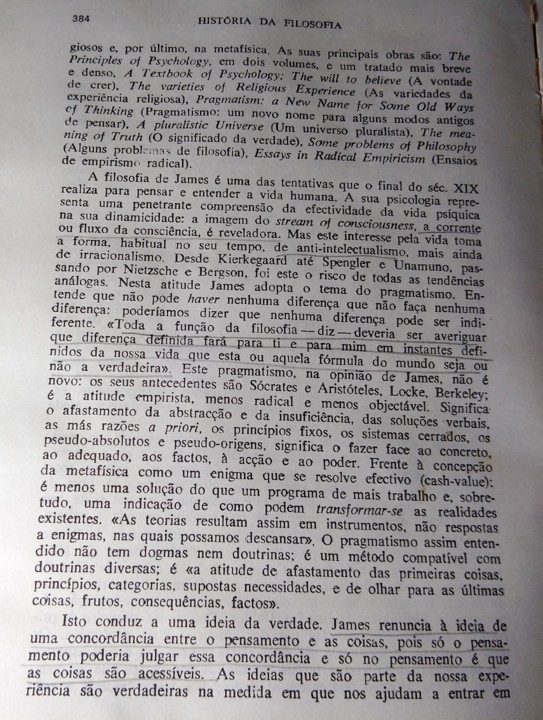

História da Filosofia, Julián Marías.
*
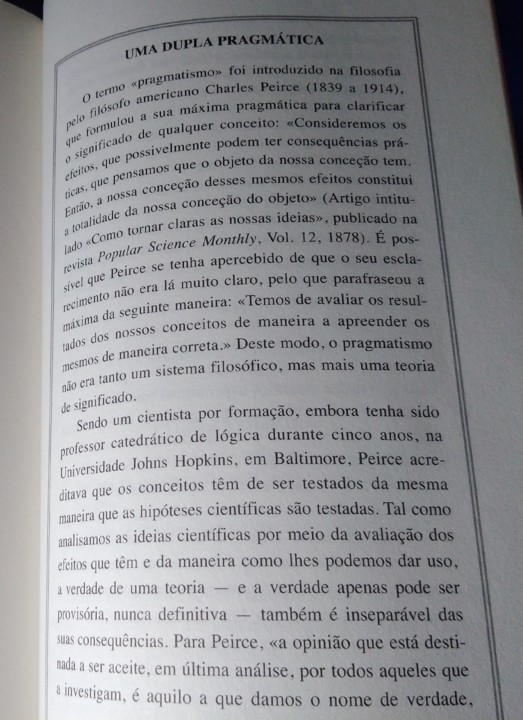
Filosofia para Pessoa com Pressa, Lesley Levene.
*
Let us now approach the subject of logic, and consider a conception which particularly concerns it, that of reality. Taking clearness in the sense of familiarity, no idea could be clearer than this. Every child uses it with perfect confidence, never dreaming that he does not understand it. As for clearness in its second grade, however, it would probably puzzle most men, even among those of a reflective turn of mind, to give an abstract definition of the real. Yet such a definition may perhaps be reached by considering the points of difference between reality and its opposite, fiction. A figment is a product of somebody's imagination; it has such characters as his thought impresses upon it. That those characters are independent of how you or I think is an external reality. There are, however, phenomena within our own minds, dependent upon our thought, which are at the same time real in the sense that we really think them. But though their characters depend on how we think, they do not depend on what we think those characters to be. Thus, a dream has a real existence as a mental phenomenon, if somebody has really dreamt it; that he dreamt so and so, does not depend on what anybody thinks was dreamt, but is completely independent of all opinion on the subject. On the other hand, considering, not the fact of dreaming, but the thing dreamt, it retains its peculiarities by virtue of no other fact than that it was dreamt to possess them. Thus we may define the real as that whose characters are independent of what anybody may think them to be.But, however satisfactory such a definition may be found, it would be a great mistake to suppose that it makes the idea of reality perfectly clear. Here, then, let us apply our rules. According to them, reality, like every other quality, consists in the peculiar sensible effects which things partaking of it produce. The only effect which real things have is to cause belief, for all the sensations which they excite emerge into (W3.272) consciousness in the form of beliefs. The question therefore is, how is true belief (or belief in the real) distinguished from false belief (or belief in fiction). Now, as we have seen in the former paper, the ideas of truth and falsehood, in their full development, appertain exclusively to the experiential method of settling opinion. A person who arbitrarily chooses the propositions which he will adopt can use the word truth only to emphasize the expression of his determination to hold on to his choice. Of course, the method of tenacity never prevailed exclusively; reason is too natural to men for that. But in the literature of the dark ages we find some fine examples of it. When Scotus Erigena is commenting upon a poetical passage in which hellebore is spoken of as having caused the death of Socrates, he does not hesitate to inform the inquiring reader that Helleborus and Socrates were two eminent Greek philosophers, and that the latter, having been overcome in argument by the former, took the matter to heart and died of it! What sort of an idea of truth could a man have who could adopt and teach, without the qualification of a perhaps, an opinion taken so entirely at random? The real spirit of Socrates, who I hope would have been delighted to have been "overcome in argument," because he would have learned something by it, is in curious contrast with the naive idea of the glossist, for whom discussion would seem to have been simply a struggle. When philosophy began to awake from its long slumber, and before theology completely dominated it, the practice seems to have been for each professor to seize upon any philosophical position he found unoccupied and which seemed a strong one, to intrench himself in it, and to sally forth from time to time to give battle to the others. Thus, even the scanty records we possess of those disputes enable us to make out a dozen or more opinions held by different teachers at one time concerning the question of nominalism and realism. Read the opening part of the "Historia Calamitatum" of Abelard, who was certainly as philosophical as any of his contemporaries, and see the spirit of combat which it breathes. For him, the truth is simply his particular stronghold. When the method of authority prevailed, the truth meant little more than the Catholic faith. All the efforts of the scholastic doctors are directed toward harmonizing their faith in Aristotle and their faith in the Church, and one may search their ponderous folios through without finding an argument which goes any further. It is noticeable that where different faiths flourish side by side, renegades are looked upon with contempt even by the party whose belief they adopt; so completely has the idea of loyalty replaced that of truth-seeking. Since the (W3.273) time of Descartes, the defect in the conception of truth has been less apparent. Still, it will sometimes strike a scientific man that the philosophers have been less intent on finding out what the facts are, than on inquiring what belief is most in harmony with their system. It is hard to convince a follower of the a priori method by adducing facts; but show him that an opinion he is defending is inconsistent with what he has laid down elsewhere, and he will be very apt to retract it. These minds do not seem to believe that disputation is ever to cease; they seem to think that the opinion which is natural for one man is not so for another, and that belief will, consequently, never be settled. In contenting themselves with fixing their own opinions by a method which would lead another man to a different result, they betray their feeble hold of the conception of what truth is.
On the other hand, all the followers of science are animated by a cheerful hope that the processes of investigation, if only pushed far enough, will give one certain solution to each question to which they can be applied. One man may investigate the velocity of light by studying the transits of Venus and the aberration of the stars; another by the oppositions of Mars and the eclipses of Jupiter's satellites; a third by the method of Fizeau; a fourth by that of Foucault; a fifth by the motions of the curves of Lissajoux; a sixth, a seventh, an eighth, and a ninth, may follow the different methods of comparing the measures of statical and dynamical electricity. They may at first obtain different results, but, as each perfects his method and his processes, the results are found to move steadily together toward a destined center. So with all scientific research. Different minds may set out with the most antagonistic views, but the progress of investigation carries them by a force outside of themselves to one and the same conclusion. This activity of thought by which we are carried, not where we wish, but to a fore-ordained goal, is like the operation of destiny. No modification of the point of view taken, no selection of other facts for study, no natural bent of mind even, can enable a man to escape the predestinate opinion. This great law is embodied in the conception of truth and reality. The opinion which is fated 2 to be ultimately agreed to by all who investigate, is what we mean by the truth, and the object represented in this opinion is the real. That is the way I would explain reality.
Charles S. Peirce, How to Make Our Ideas Clear, pp. 286-302.
